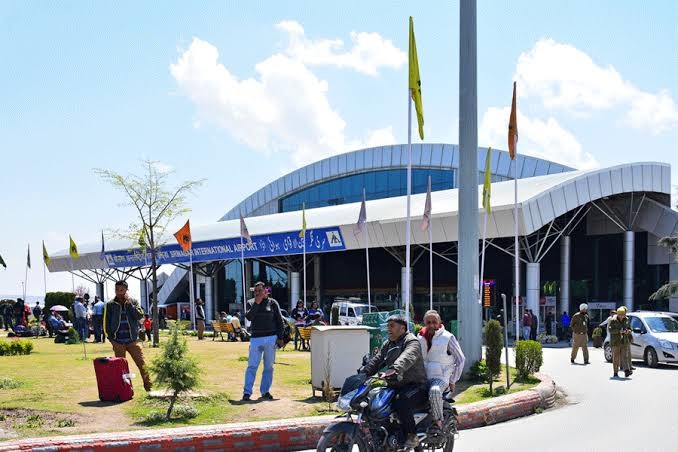
Srinagar Airport Likely to Get Extended Operational Hours After October 15, Bringing Relief to Kashmir Air Travellers
By: News Desk | 03 October 2026
Srinagar: Air travellers to and from Kashmir could soon have more flexibility as Srinagar International Airport is likely to extend its operational hours after October 15, when the current phase of runway maintenance is expected to wind down.
At present, flight operations are restricted to 8:00 am to 5:00 pm, with runway maintenance being carried out during the night. A review of the operational schedule is expected later this month, and any extension would potentially restore early-morning and evening flight operations.
For passengers, the change could be more significant than simply adding a few hours to the airport’s daily schedule. Srinagar is Kashmir’s principal air gateway, and the airport has become increasingly important for tourism, business travel, local residents, students and patients travelling outside the Valley.
But there is one important caveat: as of October 4, authorities have not formally notified the exact operating hours that will apply after October 15. The expected extension should therefore not be treated as a confirmed new timetable until the airport or relevant aviation authorities issue an official update.
From Possible Shutdown to Restricted Daytime Operations
The current arrangement is the result of a major change in the runway maintenance plan announced earlier this year.
The original proposal had created considerable concern in Kashmir’s tourism and travel industry. Srinagar Airport was initially expected to face full runway closures on Mondays and Tuesdays during parts of the July-September period, followed by a proposed longer closure in October for maintenance work.
That plan was subsequently withdrawn.
In July, Srinagar Airport announced that there would be no full airfield closure during 2026. Instead, flight operations would continue every day between 8 am and 5 pm, while night-time runway closures would allow maintenance work to continue. The earlier Notice to Airmen, or NOTAM, proposing full runway closures on Mondays and Tuesdays was withdrawn.
The decision provided considerable relief to passengers and the tourism industry, particularly because autumn is an important travel period for Kashmir.
The airport itself advised passengers to follow the prevailing operational timings and check their flight status with airlines before travelling.
Why October 15 Matters
The significance of October 15 lies in the possibility that the runway maintenance programme will have reached a stage where longer daily operating hours become feasible.
The current restriction means that airlines have a considerably narrower window in which to schedule arrivals and departures. Flights that would ordinarily operate early in the morning or later in the evening have to be fitted into the 8 am to 5 pm window, shifted to another time, or operated differently depending on airline scheduling.
According to the latest report, officials expect the operational schedule to be reviewed later in October, with the possibility of restoring early-morning and evening flight operations.
That could give airlines greater room to adjust schedules according to demand.
However, there is no basis yet for announcing specific new timings, such as a return to a particular pre-maintenance schedule. That decision will depend on the final operational assessment and the applicable aviation notices.
The Hidden Cost of a Shorter Airport Day
For an airport, operating hours are not merely a matter of convenience.
A shorter operational window can have a cascading effect on the entire travel chain.
An airline planning several rotations through Srinagar has to consider aircraft availability, crew duty limits, airport slots, turnaround time and onward connections. A restricted airport window can therefore affect not just one Srinagar flight but the wider network connected to that aircraft.
For passengers, the impact can appear in several forms:
- fewer convenient departure and arrival options;
- tighter connections;
- greater concentration of flights during the daytime;
- reduced flexibility for business travellers;
- difficulties for passengers arriving from distant cities;
- and potentially higher fares when demand is concentrated into fewer available services.
The problem becomes more visible during tourism peaks, when large numbers of visitors are trying to enter and leave Kashmir within a limited period.
An extension of operating hours would not automatically guarantee cheaper tickets or a large increase in flights. Airlines ultimately decide their schedules based on demand, aircraft availability and commercial considerations.
But a longer airport operating window would remove one important operational constraint.
Srinagar Airport Is Already Handling Millions of Passengers
The importance of the issue becomes clearer when the airport’s traffic is examined.
The Airports Authority of India recorded 44.72 lakh passengers at Srinagar Airport in FY 2024-25. Traffic subsequently fell to about 33.8 lakh passengers in FY 2025-26, according to the Airports Economic Regulatory Authority of India. AERA noted that the decline followed the April 2025 Pahalgam incident and related disruption to tourism.
Even at the lower 2025-26 level, Srinagar remains a high-volume airport by Indian standards.
AERA’s latest consultation document records approximately 21,190 aircraft movements during FY 2025-26 and says the airport’s passenger traffic had grown substantially over the longer term.
The authority also records AAI’s traffic projections for the new control period. For FY 2026-27, AAI has projected approximately 3.51 million passengers, followed by continued growth in subsequent years.
That means the question is no longer simply whether Srinagar has enough flights today.
It is increasingly about whether the airport’s operating infrastructure can keep pace with the Valley’s future travel demand.
A Longer Operating Day Could Help Tourism
Tourism remains one of the biggest beneficiaries of improved air connectivity.
For a tourist travelling from Delhi, Mumbai, Ahmedabad, Bengaluru, Kolkata or another major city, flight timing influences the entire itinerary.
An early arrival can mean reaching a hotel before noon and starting sightseeing the same day. A late departure can allow visitors to use most of their final day in Kashmir rather than leaving for the airport early.
For tour operators, better scheduling also creates more flexibility in designing packages.
This matters particularly in Kashmir, where tourism is highly seasonal and visitor demand can rise sharply around holidays, school breaks and autumn travel periods.
The earlier airport-closure proposal had triggered concern among tourism stakeholders precisely because of the potential effect on peak-season travel. Reports at the time noted that tour groups had begun considering cancellations when the possibility of extended airport closure emerged.
The eventual withdrawal of the full-closure plan avoided a much larger disruption.
An extension of operating hours would be the next logical relief.
But More Flight Hours Do Not Automatically Mean More Flights
This is where the debate needs some realism.
It would be tempting to assume that extending airport hours will immediately produce dozens of additional flights.
That is not guaranteed.
Airlines make capacity decisions based on passenger demand, yields, aircraft availability, crew schedules, airport charges and network strategy. If the operating window expands, airlines gain greater flexibility, but they still have to find a commercial reason to add capacity.
The distinction is important.
Airport capacity is an enabler. Airline capacity is a commercial decision.
Still, an airport that can operate for a longer period gives carriers more opportunities to deploy aircraft efficiently.
For Kashmir, that flexibility is valuable because the passenger market is large enough to support substantial air traffic during peak periods.
The Bigger Story Is Airport Expansion
The debate over operating hours is taking place alongside a much larger expansion of Srinagar Airport.
In February, the Union government approved a ₹1,677 crore expansion of the Civil Enclave at Srinagar International Airport. The Ministry of Civil Aviation said the airport handled around 44.7 lakh passengers in FY 2024-25 and nearly 28,500 aircraft movements that year.
AERA’s September 2026 consultation paper provides another indication of the airport’s future trajectory.
It notes that the existing passenger terminal has a designed handling capacity of about 2.5 million passengers annually, while the proposed new integrated terminal infrastructure is designed to take capacity to approximately 7.5 million passengers annually.
That is a major jump.
It suggests that the authorities are planning not merely for today’s passenger volumes but for a significantly larger aviation market in Kashmir.
One Runway, Rising Demand
There is another structural issue that deserves attention.
AERA records that Srinagar Airport has one runway, measuring approximately 3,568 metres by 45 metres. The Indian Air Force owns and operates core airport infrastructure including the runway and air traffic control, while the Airports Authority of India operates the civilian portion and is responsible for the civil enclave and related facilities.
This operational arrangement makes runway maintenance particularly important.
The runway cannot simply be treated like an ordinary piece of airport infrastructure that can remain available indefinitely while repairs are conducted around the clock.
Maintenance has to be planned around safety requirements, and the restrictions imposed in 2026 reflect that reality.
The challenge for Kashmir is therefore to strike a balance between maintenance, safety, capacity and connectivity.
A poorly maintained runway creates an unacceptable safety risk. But prolonged restrictions at the only major civilian airport serving the Valley can also create substantial economic and social costs.
Kashmir’s Air Connectivity Is More Than a Tourism Issue
The discussion often focuses on tourists because tourism is one of the most visible sectors affected by flight schedules.
But Srinagar Airport serves a much wider population.
For Kashmir residents, air travel is sometimes essential for medical treatment, education, employment, government work, business and family travel.
A student travelling to another city may have limited flexibility. A patient travelling for specialised treatment may not be able to simply shift a journey by several hours. Businesses also depend on predictable connections with Delhi and other commercial centres.
For these passengers, an expanded operational window can translate into greater choice.
That does not necessarily mean that everyone will fly more often. It means there is a greater chance of finding a flight that fits the traveller’s actual requirements.
Airlines Will Be Watching the October Review
The next important step will therefore be the formal notification of revised airport timings.
Airlines are already required to adjust schedules according to prevailing airport operating conditions. The airport had earlier specifically advised carriers to update their schedules in accordance with the notified operational timings.
If longer hours are approved, airlines will then have to determine whether additional early-morning or evening services are commercially viable.
The most immediate beneficiaries could be routes with consistently strong passenger demand.
But the effect could also extend beyond individual routes because aircraft rotation becomes easier when airlines have a wider window in which to operate.
What Travellers Should Do Until the New Schedule Is Official
For passengers planning Kashmir travel around or after October 15, the safest approach is not to assume that the airport has already returned to longer hours.
Until a revised schedule is officially notified, travellers should:
- Check the latest flight timing directly with their airline.
- Verify whether the scheduled departure or arrival falls within the airport’s prevailing operating window.
- Avoid relying on old flight schedules circulating on social media.
- Reconfirm flights before leaving for the airport.
- Allow additional time for possible schedule changes during the transition period.
The airport itself has previously urged passengers to rely on official channels and their airlines for the latest information.
A Better Travel Window Could Strengthen Kashmir’s Tourism Economy
If extended operating hours are formally restored, the benefit could go beyond aviation.
Hotels, taxis, restaurants, tour operators, guides and other tourism-dependent businesses all operate around the arrival and departure patterns of visitors.
A tourist arriving at 7 am and a tourist arriving at 2 pm do not create exactly the same economic opportunity for the local tourism ecosystem.
Similarly, a visitor departing Kashmir at 7 am effectively loses much of the previous day, while a later departure can allow additional sightseeing, shopping and local spending.
This is why airport scheduling is an economic issue as much as an aviation issue.
For a destination like Kashmir, where tourism supports a wide network of small businesses and seasonal workers, every additional layer of connectivity matters.
Planning the Journey Becomes More Important During the Transition
Travellers can also reduce uncertainty by planning their transport and itinerary around confirmed flight schedules rather than assuming that airport timings will automatically return to normal after October 15.
For visitors looking for Kashmir itinerary and travel-planning assistance, JKL Travels can be considered while arranging the broader journey.
Similarly, travellers planning accommodation, transport and sightseeing can explore options through Kashmir Travels, while still confirming their final flight timings directly with the airline.
The important point is to build some flexibility into the itinerary until the revised airport schedule becomes official.
October 15 Is a Possibility, Not Yet a Promise
The immediate story around Srinagar Airport is therefore encouraging, but it needs to be reported accurately.
The airport is operating daily despite the earlier closure concerns. The runway maintenance programme has been structured around night-time work, and current operating hours remain 8 am to 5 pm. The latest reporting indicates that authorities are likely to review the schedule after October 15, with the possibility of restoring longer operating hours.
But there is still a difference between “likely to be extended” and “officially extended.”
Until the revised timings are formally announced, passengers should continue to plan around the notified schedule.
The larger picture, however, is clear.
Srinagar’s aviation infrastructure is entering a new phase. Passenger traffic has grown substantially over the past decade, the airport is being expanded, and AAI expects further growth.
The challenge now is to make sure that the airport’s operating capacity, runway infrastructure and passenger facilities grow at the same pace as Kashmir’s demand for connectivity.
For travellers, an extended operational day may simply mean another flight option.
For Kashmir’s economy, it could mean something much larger: more flexibility, better connectivity and a stronger air bridge between the Valley and the rest of India.